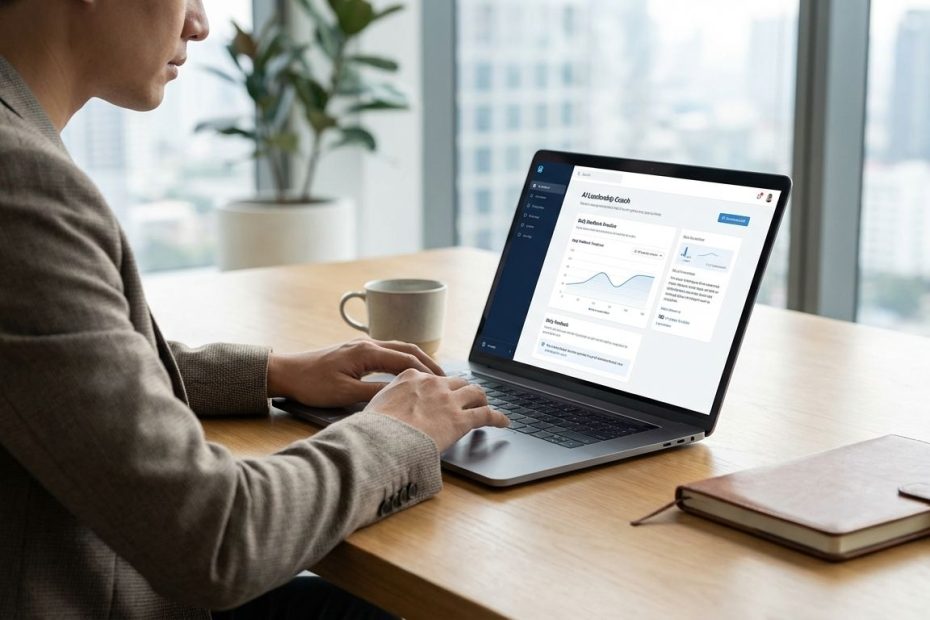
AI coaching platforms are changing how you build leadership skill because they put practice, preparation, and reflection within reach every day, not only during scheduled coaching sessions. When you implement them well, you tighten manager habits, improve conversation quality, and scale leadership development without waiting for calendar time.
You will leave this article with a clear picture of what AI coaching is, where it performs, where it breaks down, which enterprise vendors are setting the pace, and how to evaluate results without guessing. You will also get practical ways to use AI coaching in real manager workflows, from 1:1s to feedback, plus the data and governance questions that determine whether adoption sticks.
What Is An AI Coaching Platform, And How Is It Different From A Human Coach?
An AI coaching platform gives you an always-available coaching experience, usually via chat-based or voice-style conversation, that helps you prepare for leadership moments, reflect on outcomes, and build repeatable habits. You use it for quick cycles: draft an agenda, rehearse a tough conversation, pressure-test your message, or convert an issue into a plan with next actions. The best tools behave less like a search box and more like a guided coaching flow, asking clarifying questions, tracking goals, and returning to unfinished commitments.
A human coach gives you relationship, judgment, and the ability to work with ambiguity when the real issue is not what you said, it is what the organization rewards, what your boss wants, or what the team is not telling you. That human pattern recognition matters in high-stakes moments. Many enterprise platforms now position the winning model as hybrid: you use AI for daily capability building and momentum, then use a human coach to handle higher-risk leadership work where trust, accountability, and organizational reality decide the outcome. BetterUp explicitly markets this “Human + AI” pairing in its platform release messaging.
What changes inside organizations is not only the coaching method, it is the frequency of reinforcement. Traditional programs often train you once, then measure you later. AI coaching shifts you toward short practice loops that are easier to sustain, especially when the tool lives where you already work. BetterUp’s materials highlight “coaching in the flow of work,” including access through Microsoft Teams, which reduces friction and increases repeat use.
When you evaluate the difference, focus on the job-to-be-done. AI is strong for preparation, structure, and repetition. Humans are strong for meaning-making, interpersonal repair, and dealing with competing incentives. You get better leaders when you stop treating coaching as an occasional event and start treating it as an operating rhythm.
Do AI Leadership Coaches Actually Work, Or Is It Just Generic Advice?
AI leadership coaches work when you treat them as a performance tool, not a substitute for leadership judgment. If you feed them a clear objective, your constraints, and the audience you need to lead, you often get usable drafts, rehearsal prompts, and structured reflection that improves the next attempt. People reporting value in leadership communities often point to self-analysis, organizing a plan, and improving communication prep. Those are real leadership levers because most leadership failures are not knowledge failures, they are execution failures under time pressure.
You will get “generic advice” when you ask generic questions, hide the constraints, or expect the model to infer your company’s reality. You also get generic output when the platform cannot personalize to your role, level, function, and operating environment. Enterprise vendors attempt to reduce this by embedding topic libraries, role-based pathways, and organizational tailoring. CoachHub positions AIMY™ as an AI coach that delivers real-time interactive coaching conversations tailored to the coachee’s needs, which is effectively a promise of better personalization than open-ended prompting alone.
There is another failure mode that matters more than blandness: tone mismatch. AI can generate something “technically correct” that lands wrong with your team because it does not feel like you, it does not respect the history, or it ignores power dynamics. In leadership forums, managers describe unease about social backfire when leaders lean on AI for coaching or interpersonal guidance. That anxiety is not theoretical. If your team thinks you outsource empathy or accountability, trust drops fast.
The way you make AI coaching perform is by building a consistent input discipline: define your intent, declare the relationship stakes, set the tone constraints, and ask the coach to produce options, not a single script. Then you pick the option you can own. When you do that, AI becomes a multiplier for your preparation and your follow-through.
Which Companies Are Leading In AI Coaching For Leadership Development Right Now?
Several enterprise coaching vendors now present AI coaching as a core part of leadership development, not an add-on experiment. They vary by model: some build AI as a companion to a human-coach network, others position AI as the primary coach with enterprise customization. Your selection should depend on how your organization already runs development, the maturity of your HR tech stack, and how much governance you need.
BetterUp has publicly announced an AI coach offering and continues to ship platform updates that position AI coaching alongside human coaching at scale. BetterUp’s product messaging emphasizes daily capability building through AI plus human coaching for higher-stakes growth work, and it also promotes integrations that bring the experience into common workflows, including Microsoft Teams. BetterUp also references broader platform capabilities and integrations in its release content, reinforcing that it is building a connected system rather than a standalone chatbot.
CoachHub markets AIMY™ as an intelligent AI coach for the global workforce, focused on interactive coaching conversations that respond in real time. For organizations that already use CoachHub for coaching programs, this type of AI layer typically aims to fill the gap between coaching sessions and increase coaching frequency without increasing coach hours. That matters when your leadership population is large, distributed, or frontline-heavy.
AceUp positions its offering as AI-powered coaching within leadership and team development programs, with an “AI companion” angle designed to support the broader coaching process. Practically, this usually means your leaders get prompts, suggestions, and structured nudges tied to goals and program outcomes, paired with measurement and analytics that program owners can use to monitor adoption and progress.
Valence markets an AI-first coaching direction with its AI coach, Nadia, and highlights enterprise customization as a differentiator. Valence also promotes deployment through enterprise channels, including an app listing in Microsoft’s marketplace, which signals a go-to-market focus on corporate distribution and IT-friendly rollout.
Leadership development buyers should also watch how these vendors define “AI coaching.” One vendor may mean reflective prompts and content-driven coaching. Another may mean role-play, practice, and goal tracking. Another may mean analytics and recommendations. If you treat these as interchangeable, your pilot will disappoint because the product you bought will not match the behaviors you needed to change.
How Are AI Coaching Tools Being Used Day-To-Day By Managers (1:1s, Feedback, Difficult Conversations)?
Day-to-day usage succeeds when AI coaching supports the exact moments that drain manager time and quality: 1:1 preparation, feedback delivery, conflict conversations, and post-meeting follow-through. Managers do not need another portal that feels like homework. They need a tool that shortens prep time, improves clarity, and increases consistency.
For 1:1s, the most practical pattern is: set the agenda, align on goals, capture decisions, and produce action items with owners and dates. Manager communities often discuss AI help for summarization and structuring 1:1 outputs, then using that output to follow up cleanly. This is where AI reduces cognitive load, so you spend more attention on listening and coaching rather than scrambling to remember what was decided.
For feedback and difficult conversations, AI coaching is most valuable before the conversation, not during it. You can use it to draft a message that is specific, behavior-based, and measurable, then ask it to generate alternative phrasings for a more direct tone or a more supportive tone while preserving the facts. You can also use it for rehearsal: have the coach simulate pushback, defensiveness, or confusion, then practice short, calm responses that keep you on track. BetterUp’s “Human + AI” positioning explicitly highlights AI for daily capability building, which fits this prep-and-practice use case.
For after-action reflection, AI coaching improves repeat performance by forcing you to write down what happened, what you observed, and what you will do differently. Leaders often skip this step because it feels slow. AI reduces friction by asking targeted questions and converting the answers into a plan, a checklist, or a follow-up note. That is how you get leadership development to show up in weekly behavior, not only in workshop attendance.
The adoption lever you should not ignore is access. If the AI coach sits inside the tools people already live in, usage rises. BetterUp’s documentation and platform communications point to availability in Microsoft Teams, which aligns with how enterprise managers already run their day.
What Data Do AI Coaching Platforms Collect, And How Do Privacy, Security, And HR Risk Work?
Data questions decide adoption. If leaders and employees believe coaching conversations can be used for performance action, they will self-censor or avoid the tool. That kills the value, because coaching depends on honesty about weaknesses, fears, and gaps. You need a clean separation between development support and performance management, plus clear rules for what admins can see.
At a minimum, expect these data categories in AI coaching platforms: identity and account metadata, usage and engagement metrics, selected topics and goals, and the content of coaching interactions unless the platform explicitly limits retention. Enterprise platforms often add program analytics, manager dashboards, and reporting features. BetterUp’s admin-facing communications reference platform usage views that include engagement across an organization, including feature usage and satisfaction, which indicates there are reporting surfaces intended for program operators.
Integration also matters for governance. When an AI coach is available through a corporate collaboration tool, you need controls for permissions and availability that align with your organization’s AI policies. BetterUp’s Teams-related materials indicate that access can depend on organizational GenAI permissions, which is a signal that IT and HR governance is built into deployment rather than handled informally by individuals.
Risk management here is operational, not philosophical. You need answers to a short list of non-negotiables: who can see individual chat content, what is retained and for how long, whether your organization’s data is used to train models, where the data is processed, and what audit controls exist. If a vendor cannot answer those questions cleanly in writing, the product is not ready for leadership development at scale inside a regulated or high-scrutiny environment.
Also watch the “shadow coaching” problem. When your leaders use consumer AI tools outside approved systems, you lose oversight and increase data leakage risk. A governed enterprise AI coaching platform can reduce that by giving leaders a safe place to get the help they already seek, while keeping the organization’s boundaries intact.
What Skills Are AI Coaches Best At Building, And Where Do They Fail?
AI coaches perform best on skills that break into repeatable behaviors and can be strengthened through practice. That includes structuring 1:1s, writing clear goals, turning vague feedback into behavior-based feedback, planning difficult conversations, reflecting after conflict, and building consistent follow-up habits. These are the leadership basics that separate average managers from reliable leaders, and they are often undertrained because organizations assume managers will “pick them up.”
AI coaching also helps with skill standardization. When you scale leadership development, you usually fight two enemies: inconsistency and time. AI can keep you honest about the process: define the intent, name the behavior, ask for commitment, schedule a follow-up. That consistency is not glamorous, but it is where performance management starts to work.
AI fails when the real issue is organizational power and credibility. It can draft a message, but it cannot grant you trust. It can suggest you address a conflict, but it cannot navigate your team’s history, hidden alliances, or incentive mismatches unless you provide that detail and even then you must apply human judgment. It also struggles when the right answer depends on sensitive facts you should not place into a third-party system. In those moments, a human coach or internal mentor remains the safer and more effective choice.
The best operating model is to define “AI-safe” leadership use cases and “human-required” use cases. AI-safe tends to be preparation, drafting, rehearsal, reflection, and habit tracking. Human-required tends to be sensitive personnel decisions, high-conflict mediation, re-org leadership, and anything where reputational risk is high. BetterUp’s messaging around human coaching for high-stakes breakthroughs and AI for daily capability building maps to that split.
How Do You Evaluate ROI For AI Coaching In Leadership Programs?
ROI becomes measurable when you stop treating AI coaching as a benefit and start treating it as a behavior change system. You are paying for frequency, quality, and consistency in leadership actions. If your metrics do not capture those, your results will look fuzzy and you will misread the pilot.
Start with adoption metrics that correlate with impact: activation rate, repeat usage, and time-to-first-value. If leaders do not return after the first week, the tool is not embedded into work. Then track behavior metrics that you can audit: increase in documented 1:1 cadence, increase in feedback frequency, completion of development actions, and follow-up rates after tough conversations. These are leading indicators that show whether the platform is changing how managers operate.
Then connect to business outcomes you already measure: engagement scores at the manager level, regretted attrition, internal mobility, time-to-productivity for new managers, and manager effectiveness survey deltas. Do not attribute every improvement to the AI coach. Attribute lift where you can correlate usage patterns with behavior changes and outcomes over time, using matched groups when possible.
Vendors will also sell analytics narratives. AceUp, for example, positions its platform around AI-powered coaching and data-driven recommendations connected to performance and collaboration. You should treat this as a starting point, then validate which metrics are real, which are proxies, and which are marketing.
Operationally, the strongest ROI story usually comes from reducing manager failure costs: poor feedback leading to performance drift, weak 1:1s leading to disengagement, inconsistent expectations leading to rework, and slow conflict resolution leading to team friction. AI coaching can reduce those costs when it increases consistency. That is the lever to measure.
What Is An AI Coaching Platform?
- Always-on AI that helps you prepare, practice, and reflect on leadership moments
- Builds habits through prompts, plans, and role-based guidance
- Scales coaching access between human coaching sessions
Put AI Coaching To Work In Your Leadership Operating System
AI coaching platforms shape the next generation of leaders by raising the baseline: better preparation, better follow-through, and fewer missed manager moments. You get the biggest payoff when you anchor the tool to daily workflows, then enforce clear rules on what belongs in AI coaching versus what belongs in human coaching. Vendor choice matters, yet deployment design matters more, because even the best product fails when it becomes another tab no one opens. Set governance early, measure adoption and behavior change weekly, and keep the experience close to the tools managers already use.
References
- BetterUp Launches AI Coaching
- BetterUp Fall Platform Release
- Using BetterUp In Microsoft Teams
- The BetterUp Insider (Mentions AI Coach In Microsoft Teams)
- CoachHub AIMY™
- AceUp
- Valence AI-First
- Valence: Introducing Nadia
- Nadia, AI Coach By Valence (Microsoft Marketplace)
- Reddit: Anyone Leverage ChatGPT?
- Reddit: Uneasy About Using AI For Leadership Or Coaching?
- Reddit: AI For One-On-Ones

Yitz Stern is a New York–based entrepreneur and business consultant with 20+ years of experience in alternative funding and real estate. A former CEO of Fundry and managing director at Tiger Financial Technologies, he now advises mid- to large, non-public companies on capital strategy and scalable growth while investing in multifamily real estate